REVIEW · EPHESUS TOURS
NEW: Private The Most Detailed Ephesus Shore Excursion / with Lunch
Book on Viator →Operated by OTTI Travel · Bookable on Viator
Ephesus gets better when the day has structure. This private shore excursion strings together the big hits and a few extra stops you usually miss, with a skip-the-line game plan and a Turkish lunch included. I also like the fact it’s built around a licensed English guide who can adjust the order to your pace, not the other way around. One thing to plan for: many of the major entrances are paid separately, so your final total depends on which stops you choose to include.
The vibe is practical, not rushed. Guides called out in feedback include Selin, Nesli, Mehmet, Ahmet, Tas, Asli, Özgür (Oscar), Devon, and Mary, and the common thread is clear explanations plus time to ask questions.
You’ll walk a fair amount on uneven ground. The Terrace Houses can mean stairs, so comfortable shoes and a good water plan matter, especially if you’re doing this on a hot day.
In This Review
- Key highlights worth your attention
- From Kusadasi port to Ephesus: how the pickup helps
- Price math: what you pay now vs. what you pay at the sites
- What “most tours don’t cover” looks like on the ground
- Stop 1: Meryemana (Virgin Mary’s House) in 30 minutes
- Stop 2: Ancient City of Ephesus—2 hours of the big framework
- Stop 3: State Agora—government meetings and an unexpected necropolis angle
- Stop 4: Odeion—small theatre, two jobs
- Stop 5: Temple of Domitian—an emperor temple that matters
- Stop 6: Hercules Gate—why gates were built to slow vehicles
- Stop 7: Temple of Hadrian—one of the best-preserved facades on Curetes Street
- Stop 8: Terrace Houses—worth the stairs, if you pace yourself
- Stop 9: Library of Celsus—tomb design that feels like a monument
- Stop 10: Ephesus Ancient Greek Theatre—where politics and religion met
- Stop 11: Temple of Artemis—when you can only see foundations
- Stop 12: Basilica of St. John—faith tradition meets Roman/Byzantine structure
- Lunch in Ephesus territory: what’s included and what to budget
- Optional shopping and rug/carpet demos: how to handle the sales pressure
- Is this tour a fit for you?
- Should you book this detailed Ephesus shore excursion?
- FAQ
- What’s the duration and price for this Ephesus shore excursion?
- Is pickup and drop-off included, and where do cruise passengers meet?
- Is lunch included in the tour price?
- Are the entrance fees included for all sites?
- Is the tour private and offered in English?
- Can I cancel for a full refund?
Key highlights worth your attention
- Skip-the-long-lines promise helps you spend more time in the ruins and less time waiting at gates.
- Private format means your group can set the pace, which is a big deal in a time-tight cruise day.
- Lunch is included, and drinks at lunch are not, so keep that in mind for budgeting.
- Terrace Houses are part of the circuit, giving you a rare look at daily Roman family life.
- Architectural stop-by-stop context ties streets, agoras, temples, and theatres into one story.
- Many entrances are add-ons, so check your total before you book.
From Kusadasi port to Ephesus: how the pickup helps
This excursion is designed for the real-world problem of cruise timing. You get round-trip transport by an air-conditioned Mercedes van, plus pickup and drop-off.
If you’re coming from the cruise port, you meet at the exit gate of the immigration terminal with an Otti Travel sign. If you start from a hotel, you meet at the hotel reception. The same idea applies at the airport: meet at the exit gate of the domestic terminal with the Otti Travel sign.
For me, the value here is less about fancy wheels and more about fewer logistics headaches. When your day has a hard return window, a smooth pickup and organized return can mean the difference between a relaxed ruins day and a stress day.
You can also read our reviews of more private tours in Kusadasi

Price math: what you pay now vs. what you pay at the sites
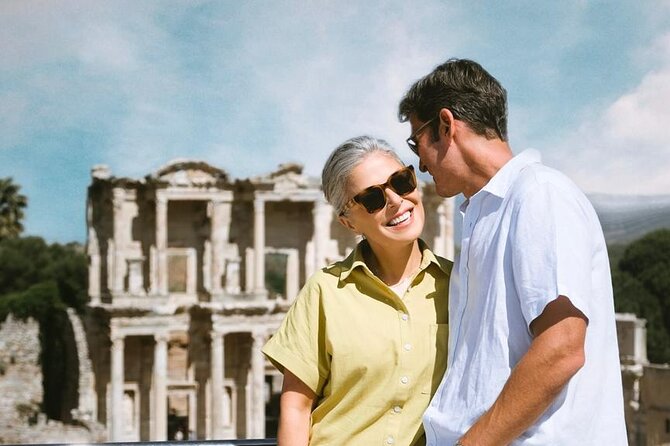
The tour price is $79.20 per person, running about 5 to 7 hours. English is included, and the guide, vehicle, parking fees, lunch, and the skip-the-lines plan are part of what you’re buying.
Here’s the part that surprises people: major sites have separate entrance fees. The tour lists these add-ons:
- Ephesus Ancient City: €40 per person
- Virgin Mary House (Meryemana): €18 per person
- Terrace Houses: €15 per person
- St. John Basilica: €6 per person
One notable detail: entry to the Ephesus Ancient Greek Theatre is included, while other stops are not. Lunch is included, but drinks at lunch are not.
So is it still good value? Usually, yes—especially for a private day. You’re paying to compress a lot of Ephesus highlights into one guided route, with a professional licensed guide and fewer waiting hours. If you’d rather roam independently, you might spend less on the tour itself, but you’ll likely lose time at entrances and miss some of the “why this place matters” context.
What “most tours don’t cover” looks like on the ground
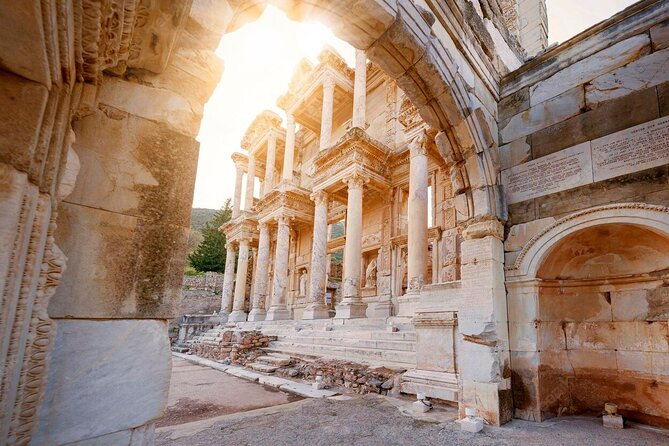
This tour earns its detailed label by layering stops that connect to how ancient Ephesus worked day to day.
You don’t just get the famous names like Celsus and the Great Theatre. You also get architectural and civic context at places such as the State Agora, the Odeion, and the Temple of Domitian, plus the Terrace Houses for a look at domestic Roman life. That matters because it changes Ephesus from a list of ruins into a functioning city.
And since this is private, you can keep moving at a pace that fits your group. In feedback, guides like Nesli and Mary were praised for adjusting to interests and needs, which is exactly what you want when some people in your group want photos and others want explanations.
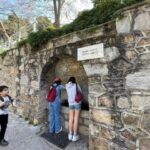
Stop 1: Meryemana (Virgin Mary’s House) in 30 minutes
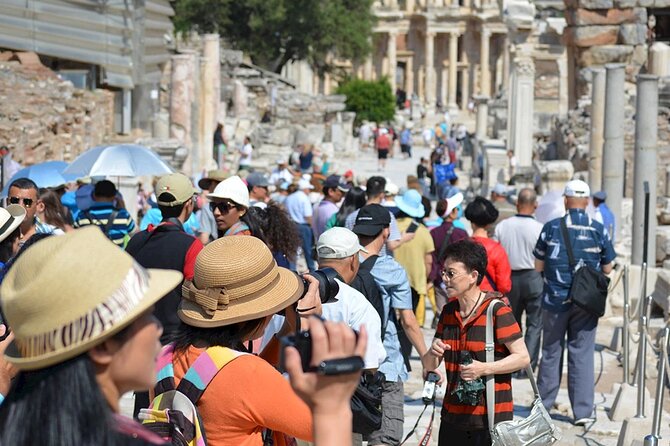
Meryemana is short on time—about 30 minutes—and the entrance fee is not included. It’s also one of those places where “less time” can actually be a benefit. You get a peaceful visit without turning it into a marathon stop.
What I like about starting here is the shift in mood. You begin with something spiritual and human-scale, then you move into the massive Roman city complex. If your group has teens or non-archaeology fans, this first stop can help everyone feel oriented before the ruins start stacking up.
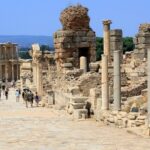
Stop 2: Ancient City of Ephesus—2 hours of the big framework
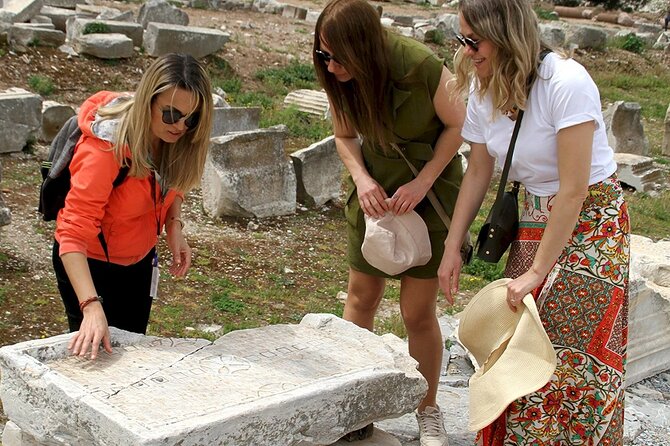
The main ancient city segment runs about 2 hours and is where you’ll see the classic highlights and the supporting characters of Ephesus.
Expect a route that can include Harbour Street, Marble Street, gate areas linked to figures like Mihridates and Mazes, and key public buildings such as the Commercial Agora and the latrina (public toilets). You may also see the Hadrian Temple area and the Scolastica Baths, plus features like Trajan Fountain, Curetes Street, Polio Fountain, and the Memnius Monument.
There’s also a “city rhythm” advantage to this specific stop list. By mentioning streets and public spaces together—rather than only monuments—you get a clearer sense of how people moved, met, debated, and worshipped.
Two practical cautions:
- You’re paying separate entrance at Ephesus Ancient City (€40 per person). Budget for it.
- Uneven paving and sun exposure add up. I’d treat this day like a moderate hike with breaks, not a museum stroll.
You can also read our reviews of more tours and experiences in Kusadasi
Stop 3: State Agora—government meetings and an unexpected necropolis angle
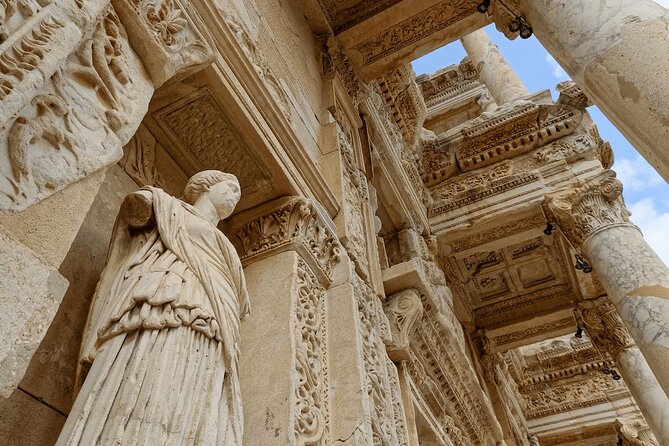
The State Agora is a quick stop (about 15 minutes) but it’s interesting in a smart way. You’re not just looking at an open square. You’re looking at a civic business/meeting space from the Roman period, used for governmental discussions.
This stop also includes a historical twist from excavation findings: graves from the 7th–6th centuries B.C. and an archaic sarcophagus, plus a clue about land use shifting over time.
One practical detail you might notice here is the water reservoir at the corner of the agora, connected to the Pollio Aqueduct system. That’s the kind of link many tours skip—yet it helps you understand how a city like this supported daily life.
Stop 4: Odeion—small theatre, two jobs
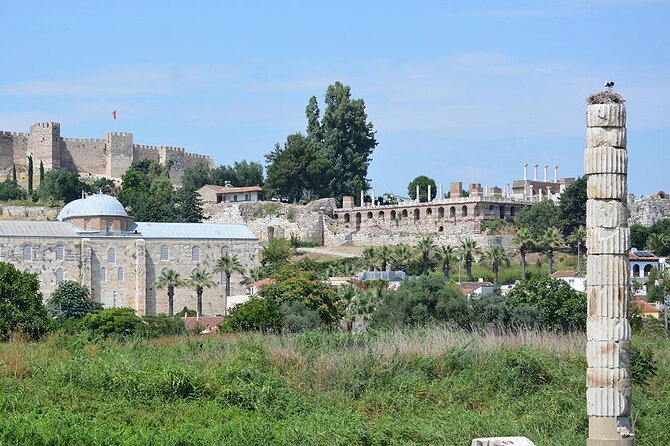
The Odeion is another short stop (about 15 minutes). It looks like a smaller theatre, but it had a double role.
The building served as a Bouleuterion for meetings of the Senate-like council and also as an Odeum used for performances. Capacity is listed as 1500 spectators, and the design includes elements like a stage building and seating sections.
If you like architecture, this is a fun pause. You can compare it to the larger Great Theatre later in the day and see how Ephesus scaled its public entertainment and governance spaces.
Stop 5: Temple of Domitian—an emperor temple that matters
The Temple of Domitian sits on Domitian Street and is about a 15-minute visit. It’s described as the first structure in Ephesus known to be dedicated to an emperor.
Why it’s worth stopping: it’s tied to the idea of imperial permission—Domitian’s era is when the right to build an emperor temple (neocoros) is mentioned as an honor for the city. The architecture details also matter here, including the pro-style layout and column counts.
This stop is quick, but it’s one of those “click” moments where you see how religion, politics, and urban identity overlapped.
Stop 6: Hercules Gate—why gates were built to slow vehicles
The Hercules Gate stop (about 15 minutes) is small on time but strong on atmosphere. It’s linked to a relief of Hercules, and the story includes that the gate’s relief was moved in the 4th century AD, while the relief itself dates to the 2nd century AD.
What I find useful here is the urban design point: the gate narrowed access to the street and helped turn it into a pedestrian area by the fourth century. Standing near it, you can imagine a city center that cared more about people moving on foot than carts driving through.
Stop 7: Temple of Hadrian—one of the best-preserved facades on Curetes Street
Temple of Hadrian is listed as one of the best-preserved structures on Curetes Street, with about 10 minutes here. This is a “look up” stop.
You get four Corinthian columns supporting a curved arch, and a relief of Tyche (goddess of victory) in the arch area. There are also inscriptions connected to statue bases for emperors from later periods.
Short version: this stop gives you a clean view of Roman-era display architecture. It’s ideal if your legs are starting to feel it, because you can get a lot of visual payoff quickly.
Stop 8: Terrace Houses—worth the stairs, if you pace yourself
The Terrace Houses are one of the more memorable stops on the whole route, with about 30 minutes here. Admission is not included, and the ground is hilly, so expect stair steps and some climbing to reach the viewpoints.
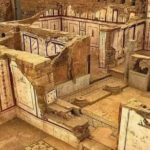
The value is that you get more than public monuments. These were “houses of wealthy Romans,” and the focus is on what family life might have looked like in Roman Ephesus. The houses were built on a right-angle street grid plan, spread across terraces, and the site includes protective roofing over mosaics and frescos.
Two practical tips:
- Plan this stop early in the day if you can, when legs are fresher.
- Bring water and take short breaks. You want to stay comfortable enough to enjoy the details.
If your group loves architecture and daily-life stories, this is the stop you’ll keep talking about later.
Stop 9: Library of Celsus—tomb design that feels like a monument
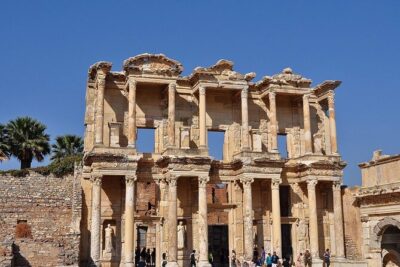
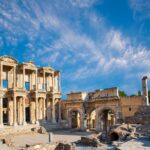
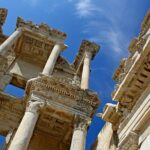
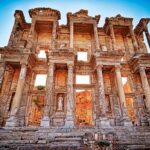
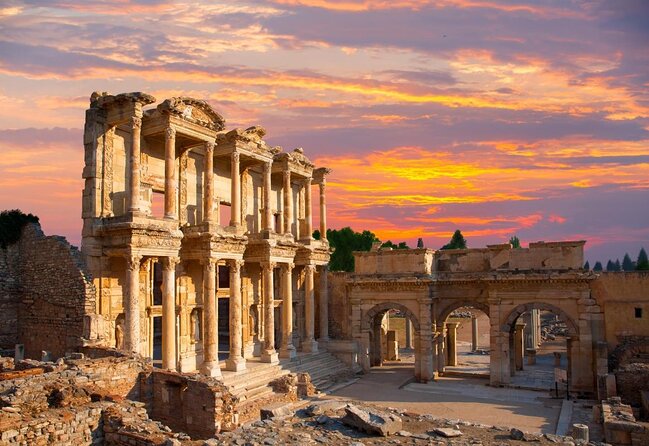
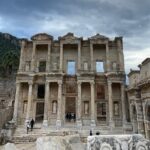
The Library of Celsus gets about 30 minutes and is included as a major photo moment. It was built in 117 A.D. as a monumental tomb for Gaius Julius Celsus Polemaeanus, and commissioned by his son.
What makes it more than a façade is the explanation around the library’s storage system. Scrolls were kept in niches, and double walls behind the bookcases helped control temperature and humidity. The library is described as holding more than 12,000 scrolls.
I like this stop because it shows engineering thinking. You’re not only seeing a pretty ruin—you’re seeing how they solved practical problems with materials and design.
Stop 10: Ephesus Ancient Greek Theatre—where politics and religion met
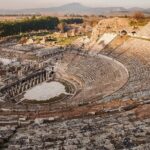
The Great Theatre stop runs about 25 minutes and is a highlight of scale. It’s described as the largest theatre in Anatolia, with 25,000 seats.
This is also where you understand how ancient performance spaces doubled as civic stages. The theatre was used for religious, political, and philosophical discussions, plus gladiator and animal fights. The design includes rows divided by diazoma walkways, and the emperor’s box is mentioned.
Since theatre entry is included, this is also one of the simplest money-saver stops on your add-on list.
Stop 11: Temple of Artemis—when you can only see foundations
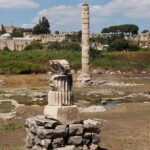
The Temple of Artemis stop lasts about 40 minutes, and admission is not included. Here’s the honest expectation set: you won’t get full towering ruins. You see foundation-level remains of what was once one of the Seven Wonders of the ancient world.
The tour context explains why: the area turned into a swamp over the centuries. It also notes that the most beautiful remains are now in museums, including the London British Museum.
This stop is still worth your time because it trains your eye. When you can only see foundations, the best experience comes from understanding what those lines and blocks used to support.
Stop 12: Basilica of St. John—faith tradition meets Roman/Byzantine structure
Basilica of St. John is another long stop (about 40 minutes) with an included sense of story. Tradition places St. John’s last years near Ephesus and says his burial was on the southern slope of Ayosolug Hill.
The site is described as a chapel built over the grave in the 4th century, later changed into a basilica during Justinian’s time. The narrative includes persecution in the era of early Christianity and the tradition of John coming to Ephesus with Mary.
If you like sites that connect archaeology to living faith tradition, this is a good finishing chapter. If your group is purely monument-focused, it can feel more “story-driven” than “structure-driven,” so pace your expectations.
Lunch in Ephesus territory: what’s included and what to budget
Lunch is included on this tour, and it’s a real part of the day, not an afterthought. Many reviews describe the meal as good and plentiful.
You should assume drinks are extra, since drinks at lunch are not included. Based on guide notes in feedback, you might even get small local touches—like tasting local figs, or a fresh squeezed pomegranate juice moment after the city walk.
For budget planning, think of lunch as a full meal plus optional drinks. If you want water and soda, that’s the place where you’ll feel the add-on costs.
Optional shopping and rug/carpet demos: how to handle the sales pressure
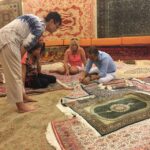
Some versions of this day include a stop tied to rug weaving or carpet demonstrations. Feedback describes a rug-making factory tour with a balance of information and sales pressure.
Here’s my practical advice if you want the demo without getting swept into buying:
- Set a budget in your head before you start.
- Treat any sales pitch as part of the experience, not a surprise.
- If you say no early and calmly, you’ll usually keep things polite.
This won’t affect your core Ephesus sites, but it can affect how “relaxed” the day feels, depending on your style.
Is this tour a fit for you?
This is a strong choice if you want:
- A private day with a licensed English guide
- Multiple Ephesus sites, including the Terrace Houses
- A timed cruise-day plan with fewer lines and round-trip van transport
- Lunch included, so you don’t have to hunt for a meal between ruins
It may not be the best choice if:
- You’re counting every euro and don’t want to add site entrance fees
- You struggle with stairs and uneven walking (Terrace Houses are a factor)
- You dislike any type of shopping stop, especially if it turns into a sales-heavy moment
Should you book this detailed Ephesus shore excursion?
I’d book it if you’re the kind of visitor who wants your time to feel intentional. With the skip-the-lines approach, a private guide, and a route that goes beyond only the biggest-name monuments, this tour gives you a fuller Ephesus picture in one day.
If your group is cost-sensitive, do the math first: the tour price plus the major entrances can add up quickly. If that total still feels worth it to you, you’ll likely appreciate the structure, the lunch, and the stops that connect buildings to how the city actually worked.
If you tell me your cruise docking time (or your hotel/arrival schedule) and how many people are in your group, I can help you sanity-check whether a 5–7 hour day will feel comfortable.
FAQ
What’s the duration and price for this Ephesus shore excursion?
The tour typically runs about 5 to 7 hours and costs $79.20 per person.
Is pickup and drop-off included, and where do cruise passengers meet?
Yes, pickup and drop-off are included. For cruise passengers, the meeting point is the exit gate of the immigration terminal of the cruise port, where you meet with a board showing the Otti Travel sign.
Is lunch included in the tour price?
Yes, lunch is included. Drinks at lunch are not included.
Are the entrance fees included for all sites?
No. The Ephesus Ancient City admission fee (€40), Virgin Mary House (€18), Terrace Houses (€15), and St. John Basilica (€6) are not included. Theatre admission is listed as included, while other stops list admission as not included.
Is the tour private and offered in English?
Yes. It is a private tour where only your group participates, and it’s offered in English.
Can I cancel for a full refund?
Yes, you can cancel for a full refund up to 24 hours in advance of the experience start time.