REVIEW · EPHESUS TOURS
Ancient City of Ephesus – Half Day Tour from Kusadasi
Book on Viator →Operated by City of Sultans · Bookable on Viator
Ephesus in four hours is a workout. You start with a gentle, downhill walk into the Roman ruins of this former provincial capital, then top it off with a short visit to the Temple of Artemis. It is a focused way to get the big visual hits—Celsus Library and the Great Theater—without spending the whole day on the road.
I especially like the practical setup: you get skip-the-line access to help you purchase tickets, plus a professional licensed guide. In multiple experiences, guides such as Medi and Pina were praised for explaining the Greek, Roman, and Turkish layers clearly, and for keeping things understandable even when the ruins are scattered and the walking is real.
The main drawback is simple: entrance fees are not included, and the time is tight. You will see the highlights, but you will not have hours to wander slowly through every corner—if you love reading every carving, an all-day option may suit you better.
In This Review
- Key points to know before you go
- Entering Ephesus: the Magnesia Gate to the Big Ruins
- The main sights you’ll hit: Odeum, Celsus, Hadrian, Trajan, and the Great Theater
- What to expect at the Temple of Artemis (and what not to expect)
- The pace, the vehicle, and the small-group advantage
- Skip-the-line ticket help and entrance fees: how to budget without surprises
- Timing in Kusadasi: how to make pickup work for you
- Optional carpet and pottery stops: what shows up on some departures
- Who should book this half-day Ephesus and Artemis tour?
- Should you book this half-day Ephesus and Temple of Artemis tour?
- FAQ
- How long is the Ancient City of Ephesus half-day tour from Kusadasi?
- Is pickup included?
- Is the tour in English?
- Are entrance fees included?
- What’s the group size limit?
- Is lunch included?
Key points to know before you go
- Downhill start from Magnesia Gate helps you follow the city’s flow instead of getting lost early.
- Small group size (max 15) makes it easier to hear your guide and adjust pacing.
- Skip-the-line ticket help saves time, though you still pay the site admission separately.
- Icon clusters in a half day: Odeum, Celsus Library, Temple of Hadrian, Fountain of Trajan, Great Theater.
- Temple of Artemis stop is short so it is best for seeing the site and understanding what made it famous.
- Pickup from cruise port and central hotels keeps the logistics painless before you step into the ruins.
Entering Ephesus: the Magnesia Gate to the Big Ruins
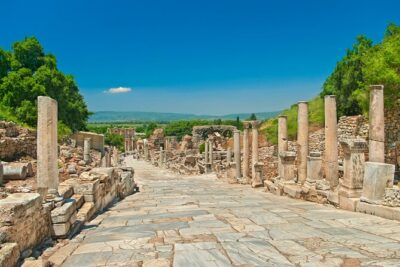
Ephesus feels like it was built to be walked. The tour route starts at the Magnesia Gate, then you drift downhill with your guide, which matters more than you’d think. On your own, it is easy to feel turned around because the ruins spread out over a wide area. With this route, you mostly move in the direction your eyes need to go.
Also, a downhill start is energy-smart. Your legs are doing the work, not your brain trying to map the site. That pacing helps when your total time is around two hours at Ephesus.
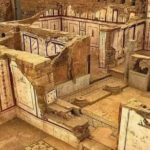
What you will notice fast is how Ephesus blends eras. Even if your visit is short, your guide can point out where the Greek roots show up, how Roman planning reshaped the city, and how the Turkish setting frames how people live with these ruins today. That layered explanation is one of the reasons this tour works as a half-day plan, not just a sightseeing checklist.
One more practical note: the route includes multiple stops that can be visually overlapping. Your guide’s job is to give you signposts so you know what you’re looking at—what was public, what was ceremonial, and what was built for crowds.
You can also read our reviews of more city tours in Kusadasi
The main sights you’ll hit: Odeum, Celsus, Hadrian, Trajan, and the Great Theater
If you like the kind of ruins where you can instantly picture real life—crowds, speeches, performances—this portion delivers. The itinerary routes you past several of the best-known structures in Ephesus, and the order is designed so each stop sets up the next.
You typically begin with the Odeum, a performance space. It’s not the biggest building at the site, but it’s a good early “anchor” because it helps you understand Ephesus as a place for gatherings, not just temples.
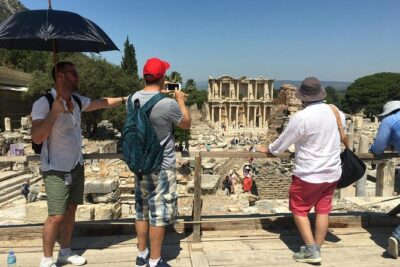
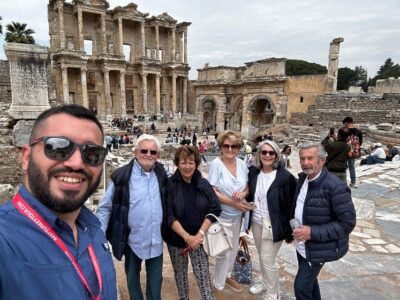
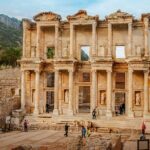
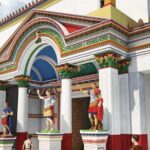
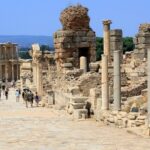
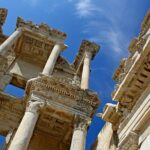
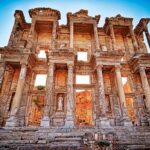
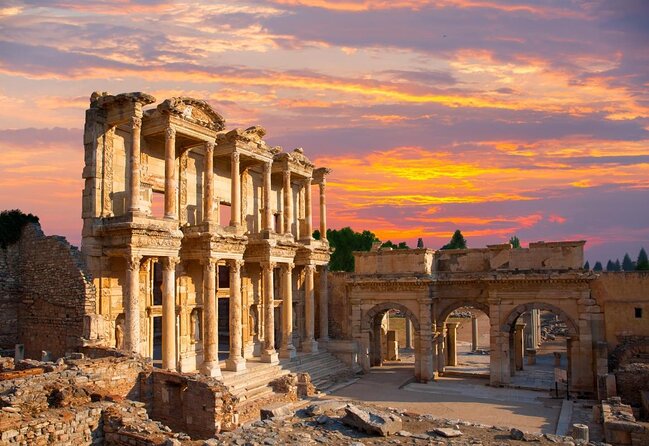
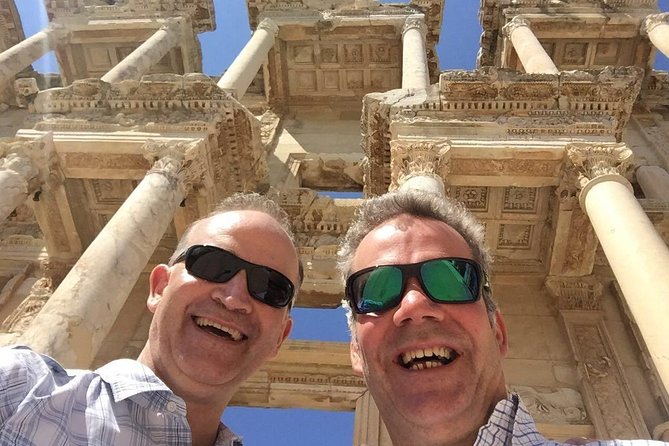
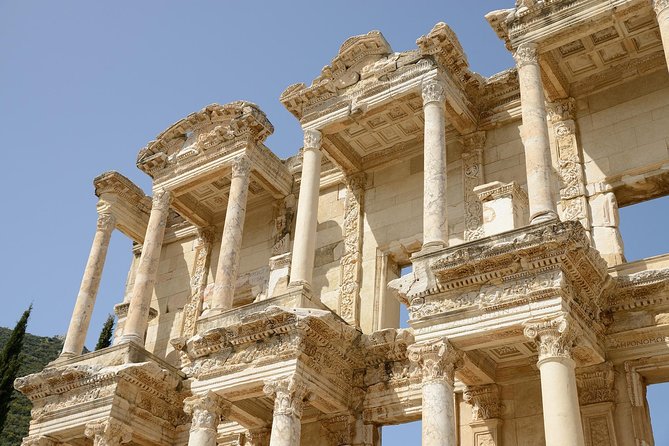
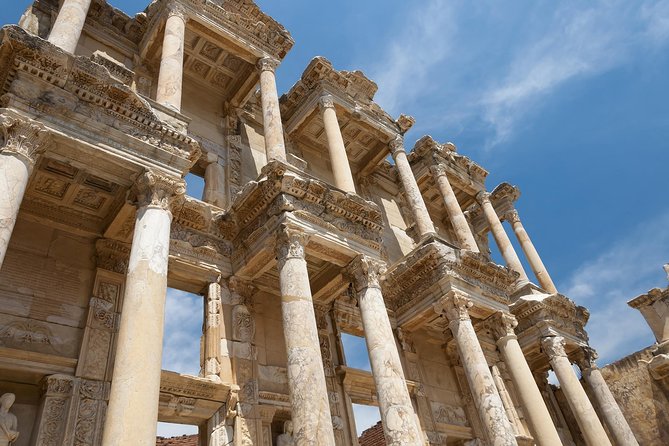
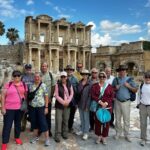
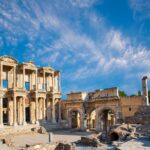
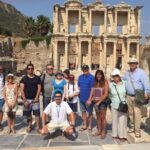
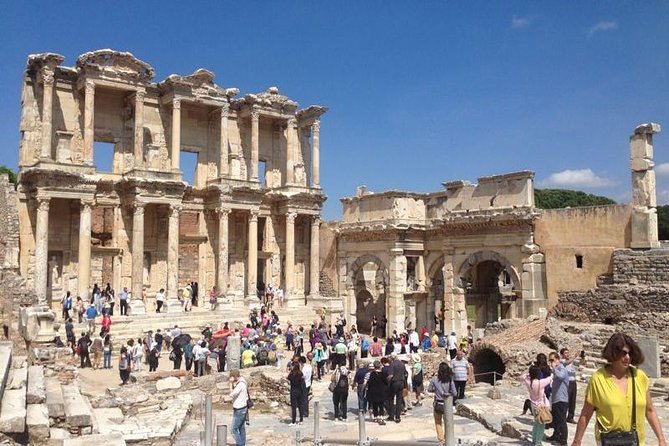
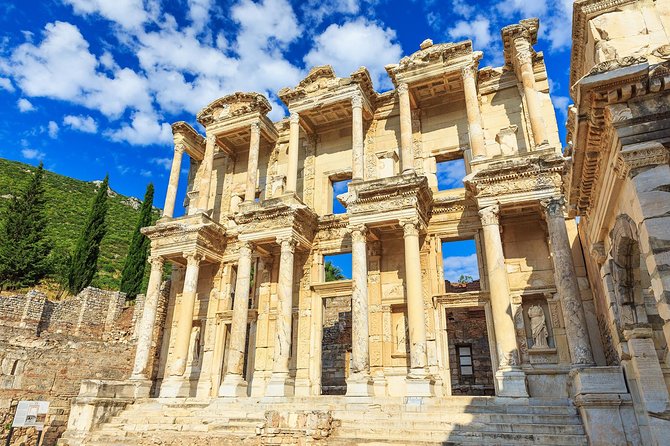
Next comes the Celsus Library, one of the most iconic façades you’ll see. Even without time to study every detail, you’ll understand why it is famous once you stand in front of it. The structure is a visual reminder that this city was once a major cultural hub, not a small town.
Then you move toward the Temple of Hadrian and the Fountain of Trajan. These stops are valuable because they show how rulers presented themselves in public spaces. Temples and monumental fountains weren’t just religious or decorative. They were also political messaging in stone—who was in charge, what the city valued, and how power appeared in everyday life.
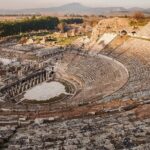
Finally, you end up at the Great Theater. This is where the “crowds in the past” feeling really clicks. The shape and scale help you imagine performances and public events. In a half day, you’re basically getting the greatest-hits path: culture, authority, and mass gatherings.
If you get short on time, focus on three things while you walk: the purpose of each space, how the buildings relate to each other, and what your guide points out as the main visual clue. That turns a fast visit into a meaningful one.
What to expect at the Temple of Artemis (and what not to expect)
The Temple of Artemis is short on time—around 45 minutes—but big on meaning. Your guide frames it as one of the seven wonders of the ancient world, and that context helps, because the site today is mostly about what remains and what it once represented.
It is also worth going in with the right expectations. You are not visiting a fully intact temple like you might picture from a movie set. Instead, you’re seeing the footprint and remnants of a monumental project that mattered across centuries. The value here is in understanding why it was considered extraordinary, not just checking off what still stands.
This stop is ideal if you want variety. After the dense Roman ruins of Ephesus, Artemis feels different—more myth-and-scale, less street-level wandering. It also gives you a mental break from the constant stone walking inside a single complex.
If you’re the type who loves to take photos quickly, Artemis is great because you can get the key views without needing hours. If you want to read every explanation panel, you might wish you had more time at this stop—or you might save that energy for an all-day Ephesus-focused visit.
The pace, the vehicle, and the small-group advantage
This is designed as a comfortable half-day tour. You ride in an air-conditioned vehicle, and the group size tops out at 15 travelers. That matters because bigger groups often turn ruins visits into line-watching. Here, it is easier to keep the flow and hear your guide.
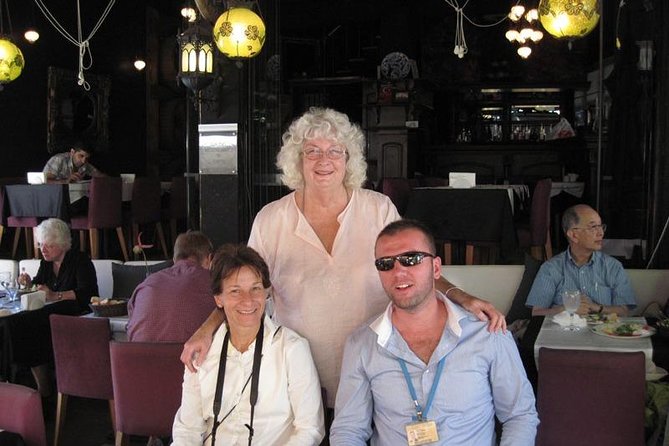
The tour is offered in English, and the guide is professional and licensed. In the experiences shared, guides like Medi and Darae were singled out for being pleasant, informative, and clear. One person even mentioned getting a strong overview of Greek, Roman, and Turkish history, which is exactly what you want when time is limited.
A couple of practical details make the day smoother, too. You also get pickup from the cruise ship port and centrally located hotels in the Kusadasi area. That’s a big deal if you don’t want to fight local transport right before a major sightseeing block.
And yes—drivers matter. In a couple of accounts, the driver was described as careful, which is reassuring when you’re starting with an early schedule and then asking your body to walk stairs, uneven stone, and long stretches.
One final pacing tip: wear shoes you trust. Even in cooler seasons, the surfaces can be uneven, and you’ll do enough walking to feel it by the end.
Skip-the-line ticket help and entrance fees: how to budget without surprises
The tour includes skip-the-line access to buy tickets, plus a licensed guide and the vehicle. What it does not include is the admission itself, so you still need to budget for entrance fees at Ephesus and the Temple of Artemis. The itinerary also notes that the admission ticket is not included for the time at Ephesus.
This is a common setup in Turkey: the tour reduces your hassle, but you handle the actual site payments on arrival (often with help from the tour staff). In practical terms, skip-the-line helps when you are arriving at a busy moment, which can happen even on a half-day plan.
How you’ll feel about the cost depends on your travel style. If you prefer “pay once, save time,” this tour makes sense. If you enjoy independent exploring and don’t mind waiting in ticket lines, you might compare options. Still, for most people—especially cruise visitors on a tight clock—time saved is the real value.
Also, remember the half-day structure. Even with skip-the-line help, you have limited hours to see everything. If you arrive late or you run out of stamina, you will feel it. Plan to be ready to board/pickup on time and keep your energy for the ruins.


Timing in Kusadasi: how to make pickup work for you
Pickups start from two main places: the cruise ship port and central hotels in Kusadasi. That’s convenient because it cuts down the “where do I meet you” stress. It also means you can spend more of your time watching ruins instead of navigating town.
The tour uses a mobile ticket, and confirmation happens at booking. You also have free cancellation, with a deadline tied to local time—but keep an eye on it if your cruise schedule or travel plans are fluid.
One more small practical note: the meeting area is described as near public transportation. That’s helpful if you need a backup plan or if you’re doing pre-tour sightseeing and want an easy way back.
For your personal planning, the key question is this: will you be tired after the ride and still want to walk? If the answer is yes, this half-day format is perfect. If the answer is no—say you want a very slow day—consider upgrading to a longer itinerary so you can take breaks without feeling rushed.
Optional carpet and pottery stops: what shows up on some departures
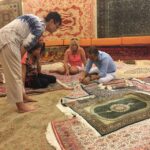
One thing that appears in some experiences is an extra detour connected to Turkish crafts—often described as carpet and pottery producers, including time at a carpet factory and even a weaving farm. People praised these stops for being low-pressure, meaning you are not forced into buying on the spot.
Now, here’s the fair warning: the core time plan you’re buying centers on Ephesus and the Temple of Artemis, and the tour data does not promise lunch or these craft stops. So treat them as a possible bonus that may vary by day and guide pacing, not as a guaranteed add-on.
If your goal is shopping, these detours can be useful because you’ll see the materials and process behind the products. If your goal is purely archaeological sites, you may not want to spend your short time on retail-adjacent experiences—though it can still be educational to see how weaving is done.
If you go this route, I recommend setting a budget before you step into any shop area. That keeps the experience enjoyable instead of stressful.
Who should book this half-day Ephesus and Artemis tour?
This tour fits you best if you want a “great results fast” day. It is especially good for:
- Cruise passengers who need a tight plan and convenient pickup.
- First-time visitors to Ephesus who want the major sites with a guide doing the navigation and interpretation.
- People who want structure: an efficient path through big ruins without spending hours figuring out what matters.
- Anyone who likes small groups and doesn’t want a noisy bus line experience.
It might not be ideal if you fall into these categories:
- You want to spend long hours reading, sketching, or wandering slowly without a time cap.
- You strongly prefer to pay less and handle tickets alone, since entrance fees are separate.
- You dislike any optional craft or shopping-adjacent stops, even if they are described as low-pressure.
If you’re traveling in winter or shoulder season, it can be especially pleasant. One experience mentioned January with good weather and very few crowds, and cooler months can make the walking feel more manageable.
Should you book this half-day Ephesus and Temple of Artemis tour?
I’d book it if your goal is to see the headline structures of Ephesus and still have energy for the rest of your day in Kusadasi. The small group size, licensed guide, air-conditioned vehicle, and skip-the-line help are a solid combination for the price of $39—especially when you consider how expensive time and logistics can feel when you’re on a cruise schedule.
I’d think twice only if you need long, slow museum-style pacing or you know you’ll want to linger at every stop. In that case, look for a longer itinerary so you can absorb Ephesus without checking the clock every 10 minutes.
FAQ
How long is the Ancient City of Ephesus half-day tour from Kusadasi?
The tour is about 4 hours.
Is pickup included?
Yes. Pickup is offered from the cruise ship port and centrally located hotels in the Kusadasi area.
Is the tour in English?
Yes, the tour is offered in English.
Are entrance fees included?
No. Entrance fees to the museums and sites are not included, and the admission ticket is listed as not included.
What’s the group size limit?
The tour has a maximum of 15 travelers.
Is lunch included?
No. Lunch is not included.