REVIEW · SELCUK
Ephesus Small Group Day Tour from Selcuk
Book on Viator →Operated by Alaturca Ephesus · Bookable on Viator
A day in Ephesus feels like stepping through layers of faith and empire. This small-group tour strings together the big-name ruins plus a couple of stops that explain how beliefs changed around the same streets.
I especially like the hotel pickup and drop-off from Selçuk, which keeps the morning stress low. And I like that lunch is included, so you’re not hunting for food mid-ruins.
One thing to plan for: your day may include extra time at shops, and that can cut into free time for the archaeology if you prefer a pure ruins-only pace.
In This Review
- Key highlights that make this tour worth your attention
- A smooth Selçuk-to-Ephesus day plan that doesn’t waste your time
- Stop 1: The House of the Virgin Mary at Bulbul Mountain
- Stop 2: Ephesus Ancient City, the “why” behind the ruins
- Stop 3: The Odeion for concerts, meetings, and local politics
- Stop 4: Temple of Hadrian on Curetes Street
- Stop 5: The Library of Celsus, where illusion helps you read the building
- Stop 6: The Great Theater—scale you can feel
- Stop 7: Temple of Artemis ruins—why one pillar still matters
- Stop 8: Isa Bey Mosque—Selçuk’s skyline after the Roman world
- Lunch, shop stops, and how to keep your day focused on Ephesus
- Price and value: what you get for about $150
- The guide experience: pace, explanations, and what to request
- Who should book this Selçuk Ephesus small-group tour
- FAQ
- FAQ
- What time does the tour start from Selçuk?
- Where do hotel pickups happen?
- How long is the Ephesus small-group day tour?
- What languages is the tour offered in?
- How many people are in the group?
- Are admission tickets included?
- Is lunch included?
- Is there a mobile ticket?
- Can I cancel for a full refund?
Key highlights that make this tour worth your attention
- Max 15 people keeps the day from feeling like a cattle-car shuffle.
- Hotel pickup in Selçuk (around 9:00 to 9:30) means you can roll straight into the day.
- Admission tickets included for every listed stop, so you’re not budgeting site-by-site.
- Temple of Artemis is shown in its true context: a single reconstructed remnant tied to the original scale.
- Celsus Library and the Great Theater come with enough explanation to make the stones make sense.
- A Virgin Mary stop at Bulbul Mountain adds a different kind of meaning to the Ephesus story.
A smooth Selçuk-to-Ephesus day plan that doesn’t waste your time
This is an all-in-one day: you meet your guide and small group at your Selçuk hotel, then ride in an air-conditioned minivan to Ephesus. The tour runs about 8 hours starting at 9:00 am, with pickup in Selçuk typically between 9:00 and 9:30.
You’ll get a mobile ticket, and the whole day is structured around set stops with set durations. That’s good news if you want an organized route, but it also means you can’t treat this like a flexible “wander and linger” day. The best approach is to go in with clear priorities: if Ephesus is your main goal, use the included time wisely and plan any optional add-ons (like extra tickets) around it.
You can also read our reviews of more tours and experiences in Selcuk.
Stop 1: The House of the Virgin Mary at Bulbul Mountain
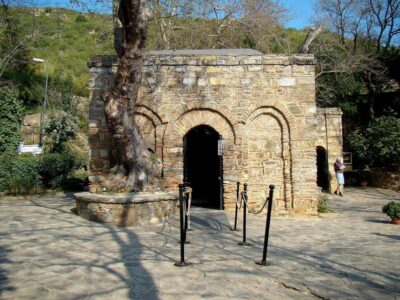
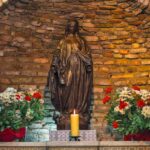
Your first major stop is the House of the Virgin Mary (Meryem Ana Evi). The idea here is that Mary spent her final years in Ephesus with St. John, commonly dated to the years 37–45 CE, and connected with either Assumption (Catholic doctrine) or Dormition (Orthodox belief).
The tour keeps this stop to about 30 minutes, and admission is included. That timing works well: you get a calm moment to take in the setting, read the significance, and still have plenty of energy for the heavier archaeology later.
If you’re interested in religion, this is a smart opening. You’re not starting with marble and emperors. You’re starting with a place people associate with devotion, memory, and pilgrimage—then you’ll watch how the story shifts as you move back into the Roman-era city.
Stop 2: Ephesus Ancient City, the “why” behind the ruins
Ephesus is the star, and you get a generous 2 hours in the ancient city itself. It’s described as Turkey’s grandest and best-preserved ancient site, and that matches the feel once you’re there: you can actually picture a working city, not just a collection of separated blocks.
Here’s what I think makes this stop click for most people: it connects trading life, religion, and the way power changes over time. Ephesus wasn’t just a marketplace. It was also a centre for the cult of Cybele, an Anatolian fertility goddess. And as centuries passed, beliefs and politics evolved, leaving new layers across the same ground.
In practical terms, the first thing you should do during your time here is get your bearings. Look at how the main streets and major buildings relate, so the later stops (library, theater, Hadrian’s temple, and Artemis remains) feel like a connected route rather than isolated souvenirs of stone.
Stop 3: The Odeion for concerts, meetings, and local politics
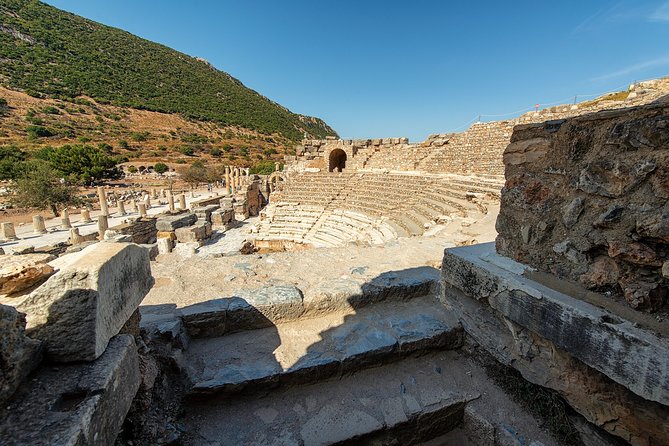
Next up is the Odeion, a small, semi-circular theater originally built in the 2nd century A.D.. It was financed by Publius Vedius Antonius and his wife Flavia Paiana, and it would have hosted public life: political meetings, social events, performances, and concerts.
You only get about 15 minutes here. That isn’t a lot, but it’s enough for a quick reset: the Odeion helps you understand that entertainment and civic life weren’t separate in ancient cities. If you tend to rush through ruins on your own, this is one of the spots where a guide’s explanation can turn a shape in the stone into a real schedule of daily life.
Stop 4: Temple of Hadrian on Curetes Street
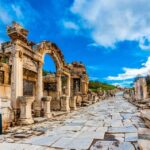
Then comes the Temple of Hadrian, a dedicated structure tied to imperial attention. This one is considered one of the best preserved and most beautiful buildings on Curetes Street. It was built in the early 2nd century AD by P. Quintilius to celebrate Hadrian’s visit to the city from Athens.
Again, expect about 15 minutes. The key value is context: you’re not just looking at an impressive façade. You’re seeing how emperors were honored locally, with architecture doing the messaging.
If your favorite part of travel is linking art, power, and daily public life, this stop tends to land well. You’ll start to notice how Ephesus used space to signal status—then you’ll see that logic echo in the later theater and library.

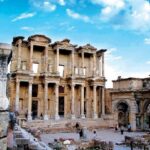
Stop 5: The Library of Celsus, where illusion helps you read the building
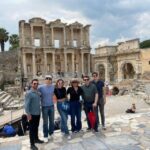
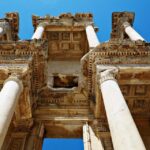
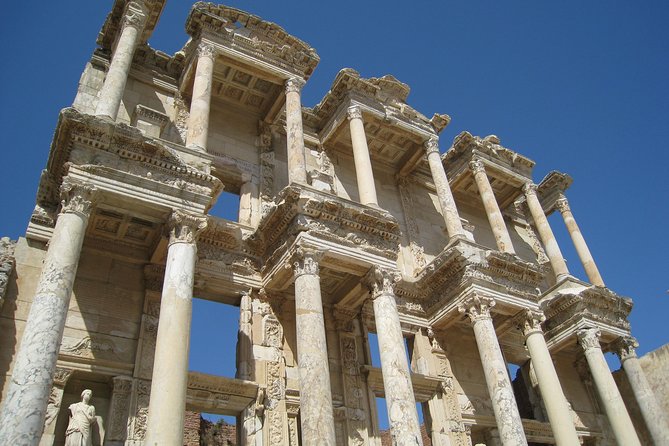
The Celsus Library (Bibliotheque de Celsus) is the best-known monument in Ephesus and it’s extensively restored. It dates from the early 2nd century AD, and it originally sat within a larger complex.
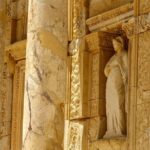
This is one of the places where the guide’s explanations can make a big difference. The library looks bigger than it is because of optical tricks: the convex façade shape and other proportions enlarge the impression of depth and height. Facade niches hold replica statues of the Four Virtues: Sophia (Wisdom), Arete (Goodness), Ennoia (Thought), and Episteme (Knowledge).
You’ll get about 20 minutes, which is enough time to:
- look up at the façade details,
- understand the symbolism,
- and take photos without feeling hurried.
My advice: treat the library like a “visual textbook.” Once you know what you’re seeing, you start recognizing the same ideas—status, learning, and public life—across the other monuments.
Stop 6: The Great Theater—scale you can feel
The Great Theater of Ephesus is the heavyweight stop. It’s described as a splendid, very impressive marble structure with a width of 145 meters. The seating area once rose up to about 30 meters, and it could accommodate up to 24,000 spectators.
This theater began in Hellenistic times, then later life in the city reshaped what you see. Even if you don’t memorize the dates, standing there makes the ancient scale feel real fast.
You’ll have about 20 minutes here. Don’t waste it by only taking a quick shot. Walk your gaze from the seats to the stage area, even briefly. It helps you understand the space as a place where people gathered—politics, culture, and community—rather than as a stone monument frozen in time.
Stop 7: Temple of Artemis ruins—why one pillar still matters
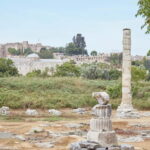
Now you switch from towering theater and libraries to the Temple of Artemis. At its peak, the temple counted 127 columns, and it’s one of the Seven Wonders of the Ancient World. But what you see today is mostly absence: a lone reconstructed pillar is all that remains in the empty field to the west.
It’s said to have been damaged by earthquakes, Goths, and plain passage of time. That “missing-ness” is exactly why this stop is meaningful. You aren’t looking at a complete building; you’re looking at the evidence of something once colossal.
Expect 15 minutes. If you like big-picture history, this is a good moment to reflect on how time dismantles even the most celebrated structures—then how later generations keep trying to remember them.
Stop 8: Isa Bey Mosque—Selçuk’s skyline after the Roman world
To finish, you visit Isa Bey Mosque in Selçuk. This stop is a helpful contrast: you leave the Roman city behind and end in a much later architectural world.
The tour frames it as a post-Seljuk/pre-Ottoman transitional style built when Selçuk was capital of the Aydin Emirate. An Arabic inscription above the main entrance says it was built in 1375. In the overview, you’ll hear about its brick minarets, Iznik-tiled domes, and a design with 12 columns, with the minarets rising above the tiled rooftops.
You’ll have about 15 minutes. It’s a short stop, but it works well as a closing note: after seeing how empires left their mark on ancient Ephesus, you see how Selçuk’s own identity and faith took shape later—still nearby, still tied to the same region.
Lunch, shop stops, and how to keep your day focused on Ephesus
Lunch is included, and drinks are not (alcoholic drinks can be purchased). That’s a normal setup for a tour day, but it matters because it affects how you budget your breaks.
Here’s the practical consideration: this route can include longer time at shops along the way. One recurring pattern that can show up on this kind of day is stops tied to craft and leather goods, sometimes with demonstrations. If you mainly want ruins time—especially if you want to move slowly through Ephesus or return to terrace-house areas—those shop hours can feel like they steal time from the archaeology.
My advice is simple: if Ephesus and the optional add-ons are your priority, ask your guide early how the day’s timing tends to work. Also be ready to make trade-offs. You can’t stretch 8 hours into unlimited free time, even with a small group.
Price and value: what you get for about $150
At $150.18 per person for roughly 8 hours, you’re paying for more than a ride. You’re paying for:
- Hotel pickup and drop-off in Selçuk
- Air-conditioned transport by minivan
- A professional guide in English
- Lunch included
- Admission tickets covered for every listed stop
This is where the value math tends to make sense. If you try to DIY this route, you’ll still be paying for entry tickets, a guide you trust, and transportation that actually gets you from one site to the next without stress. Here, those pieces are bundled.
Also, the small-group cap of 15 matters. You’re less likely to get stuck in a crowd move. It can mean better Q&A time and more chance to hear the details that make Celsus and the theater feel like living places rather than just ruins.
The guide experience: pace, explanations, and what to request
This tour runs in English, and it’s designed so the guide can offer personalized attention. That’s especially valuable at Ephesus, where the site is large and the details can blur if you don’t have someone to connect the dots.
One guide name that comes up is Begum, praised for making the experience enjoyable and well-paced. Another theme you’ll want to watch for is the balance between storytelling and on-site time. If your guide leans more toward dramatic narration than practical on-site interpretation, it can feel like you’re spending less time looking at what’s in front of you.
If you care about maximizing time in the archaeology, a smart move is to ask about any optional extra tickets you want to consider. For example, terrace houses can be a common interest at Ephesus, but they may require an additional ticket and extra time that this route’s fixed schedule might not always allow.
Who should book this Selçuk Ephesus small-group tour
Book it if you want:
- a guided day at Ephesus without planning logistics yourself,
- admission tickets included and a guided route that hits the major highlights,
- a small group experience capped at 15 people,
- and a mix of Roman Ephesus plus a meaningful pilgrimage stop.
Consider passing or adjusting expectations if:
- you dislike shop stops and want a pure ruins-only day,
- you’re chasing extra-ticket add-ons and need extra time beyond the scheduled stops,
- or you want long stretches of free wandering without any set timing.
FAQ
FAQ
What time does the tour start from Selçuk?
Start time is 9:00 am. Pickup from Selçuk is usually between 9:00 and 9:30 am.
Where do hotel pickups happen?
The tour includes hotel pick-ups. Pickup time can vary based on where you’re staying and other pick-up points, and the final time is set the day before.
How long is the Ephesus small-group day tour?
The duration is about 8 hours.
What languages is the tour offered in?
The tour is offered in English.
How many people are in the group?
This tour has a maximum of 15 travelers.
Are admission tickets included?
Yes. Admission tickets are included for all listed stops: the House of the Virgin Mary, Ephesus Ancient City, the Odeion, the Temple of Hadrian, the Celsus Library, the Great Theater, the Temple of Artemis, and Isa Bey Mosque.
Is lunch included?
Yes. Lunch is included. Drinks are not included, and alcoholic drinks can be purchased.
Is there a mobile ticket?
Yes, the tour provides a mobile ticket.
Can I cancel for a full refund?
Yes. Free cancellation is available, and you can cancel up to 24 hours before the experience for a full refund.
If you want a well-paced, guided Ephesus day that bundles tickets, transport, and lunch, this is a strong option. Just go in expecting a set schedule—and decide ahead of time how much patience you have for shop stops versus archaeological time.